
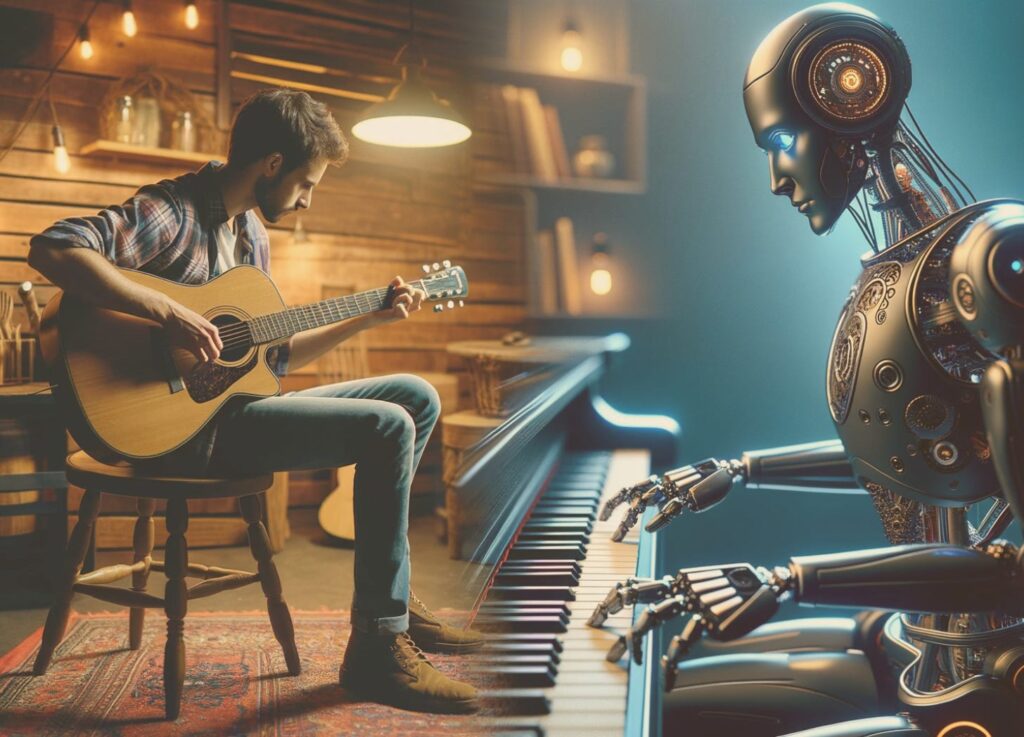
A few years ago, asking if AI could create real music would have seemed ridiculous. AI generated tracks sounded robotic, lifeless, and honestly pretty bad. But in 2025, things have changed dramatically. AI music generators like Suno, Udio, and MusicLM can now create complete songs with vocals, instruments, and even emotional depth in just seconds.
This raises a question that makes musicians uncomfortable: Is AI music actually getting as good as human music? Can a computer algorithm capture the soul, creativity, and emotional connection that makes music powerful? Let’s dig into what AI can and cannot do in 2025.
How AI Music Generation Actually Works
AI music generators don’t just randomly throw notes together. They use advanced neural networks trained on millions of songs across every genre imaginable. These systems analyze everything from chord progressions and melodies to rhythm patterns and emotional cues.
When you give an AI tool a prompt like “create a sad piano ballad about lost love,” the system draws on all that training data to generate something new. It understands which chord progressions create sadness, which tempos feel reflective, and which instrumental choices enhance emotion.
The best AI music tools in 2025 can generate full songs complete with multiple instruments, dynamic changes, lyrics, and vocals that sound surprisingly human. Tools like Suno and Udio have become so good that most people cannot tell the difference between AI generated music and human composed tracks in blind tests.
The Quality Gap Is Closing Fast
Just two years ago, AI music was easy to spot. The timing felt off, transitions sounded awkward, and the overall vibe was just wrong. Today, that gap has nearly disappeared for certain types of music.
What AI Does Really Well
- Background music and instrumentals. AI excels at creating ambient tracks, lo fi beats, and background music for videos or podcasts. These tracks often sound professional and polished.
- Genre matching. Tell an AI you want jazz, EDM, or classical music, and it will nail the stylistic elements. The chord progressions, instrumentation, and structure will all fit the genre perfectly.
- Technical execution. AI never misses a beat or plays a wrong note. The technical quality is consistently high because there are no human errors.
- Production quality. AI generated tracks come out mixed and mastered. They sound ready for release without needing additional production work.
Where AI Still Falls Short
- Despite impressive progress, there are areas where human musicians still have the advantage.
- Emotional authenticity. AI can mimic sadness or joy, but it has no lived experiences to draw from. It cannot write from heartbreak, loss, or genuine happiness because it has never felt those things. Human listeners often sense this missing depth, even if they cannot explain exactly what feels off.
- Creative rule breaking. The best human artists know when to break musical rules for creative effect. AI tends to follow patterns more rigidly because that’s what it learned from its training data. It can copy innovation but struggles to create truly original approaches.
- Cultural context. Music often reflects specific moments in time, social movements, or cultural experiences. AI misses these nuances because it lacks understanding of history and human experience beyond data patterns.
- Intentional imperfection. Tiny timing variations, slight pitch imperfections, and other human quirks give music character. While some AI tools now add these imperfections artificially, it still feels different from genuine human performance.
Can People Actually Tell the Difference?
This is where things get interesting. Multiple studies in 2025 have tested whether listeners can distinguish AI music from human music. The results might surprise you.
Research from universities and tech companies shows that average listeners perform barely better than random guessing when trying to identify AI generated tracks. Even trained musicians struggle with genres outside their specialty. A classical pianist might catch AI generated classical pieces but miss AI pop songs completely.
However, when listeners know a track is AI generated, their perception changes. Studies show people rate the exact same song differently depending on whether they think it came from a human or a machine. Music labeled as human created gets higher ratings for emotional depth and authenticity, even when it is actually AI generated.
This suggests the bias is partly psychological. We want to believe human music has something special that machines cannot replicate, and that belief influences what we hear.
The Role of AI in Music Creation Today
Rather than replacing musicians, AI is becoming a tool in the creative process. Many artists use AI to speed up certain tasks or overcome creative blocks.
Songwriters use AI to generate lyric ideas or suggest chord progressions when they feel stuck. Producers use AI to create background elements or fill out arrangements. Content creators use AI to generate royalty free music for videos without worrying about copyright issues.
If you create content and need music quickly, exploring AI music generation tools can save you time and money. There are dozens of platforms designed specifically for different use cases, from social media content to commercial projects.
The question is not really whether AI will replace human musicians entirely. Instead, AI is changing what it means to be a music creator and how the creative process works.
Legal and Ethical Questions
AI music raises complicated copyright issues. These tools train on millions of existing songs, learning patterns from copyrighted material. Some AI systems have been caught generating output that sounds extremely similar to specific songs from their training data.
Major record labels have filed lawsuits against AI music companies, claiming they use copyrighted music without permission. The companies argue that learning from existing music is not the same as copying it. Courts will need to decide where the line falls.
There’s also the question of authenticity in an age where anyone can generate professional sounding music instantly. If an artist uses AI to create their track, should they disclose that? Does it matter to fans? These ethical questions do not have clear answers yet.
When building your own music content or promoting your work, understanding these copyright complexities is important. Our guide on using copyrighted music on Instagram legally covers similar territory for social media creators.
What Musicians Think About AI
Opinions in the music community are split. Some artists see AI as a threat to their livelihood. If anyone can generate decent music for free, why would people pay musicians?
Others view AI as just another tool, like synthesizers or drum machines were in previous decades. Those technologies initially scared musicians too, but they ended up creating entirely new genres and opportunities.
Many working musicians are pragmatic about it. They use AI for specific tasks while focusing their human creativity on the parts that require emotional depth, unique perspective, or cultural understanding. After you create your music, you still need to get it heard. Check out our strategies for how to promote your music as an artist.
The Future of AI and Human Music
Looking ahead, AI will only get better. Models will become more sophisticated, training data will improve, and output quality will continue rising. Within a few years, AI might be truly indistinguishable from human composers in blind tests across all genres.
But does that mean human music becomes irrelevant? Probably not.
Music has always been about more than just technical quality. People connect with artists, not just songs. They want to know the story behind the music, the struggles the artist overcame, the message they are trying to share. AI cannot provide that human connection.
Live performances will remain uniquely human experiences. The energy of a concert, the interaction between artist and audience, and the unpredictability of live music cannot be replicated by algorithms.
Original artistic vision will still matter. AI can create competent music across genres, but pushing boundaries and defining new sounds requires the kind of creative risk taking that comes from human intuition and experience.
Practical Implications for Artists and Creators
If you are a musician or content creator in 2025, AI music is both a challenge and an opportunity.
The challenge is that competition increases. More people can create decent sounding music, which means standing out becomes harder. You cannot rely on technical skill alone anymore.
The opportunity is that production barriers drop dramatically. You can create full arrangements, generate ideas quickly, and produce content faster than ever before. Independent artists can compete with bigger productions because AI levels the playing field.
The key is focusing on what makes you uniquely human. Your personal story, your specific perspective, your lived experiences. These are things AI cannot replicate. Use AI for the technical grunt work, but keep your creative vision and emotional authenticity at the center.
The Bottom Line
So is AI music getting as good as human music? The answer is complicated.
Technically, yes. AI can now create tracks that sound professional and polished. Most listeners cannot reliably distinguish AI from human music in blind tests.
Emotionally and creatively, not quite. AI lacks the lived experience, cultural understanding, and genuine emotion that gives human music its deepest impact. It can mimic these qualities convincingly but cannot truly embody them.
Practically, it depends on context. For background music, stock tracks, and certain commercial applications, AI music works great. For music meant to connect deeply with listeners or push creative boundaries, human musicians still have the edge.
The real story is not AI versus humans. It is about how AI changes the music landscape and what that means for creators and listeners. Music will continue evolving, just as it has with every technological shift throughout history.
Human creativity is not going away. It is just getting new tools. What we do with those tools will determine whether AI becomes a threat or an opportunity for the future of music.